Posts

Back to Training

I managed to return back to training for the first time this year a couple of weeks ago.  My goodness how I had missed it! Good points from the session: I retained my overall fitness, and finished the session tired, but not too drained The work I had put into sanseru over my break actually paid off, and I was able to keep up with the others, and work the applications to a similar level. It was my first ever black belt class and I was pleased that I was able to work at that level for the entire session It was very beneficial being able to spend more than 1/2 an hour on a karate session Things which stood out for improvement (for me) Our school, while emphasising a practical, HAPV and bubishi-influenced approach, also does some sparring-specific/general techniques including the gamut of high and varied kicks.  I'm not a huge fan of these, so I spent almost no time practising them on my break.  It took me almost a week ...

Saifa #2 - Core principles and techniques

This is my own current understanding of what is going on in saifa, based on my experience of it solo and the bunkai I have learned from it.  I haven't had a chance to talk about any of this with my instructor yet, so in a later post, I may change my views (or maybe not - I can be quite stubborn at times). Saifa can be broken down into 6 (7 with the mawashi uke at the end) technique sequences.  The first is the initial angled shift forwards, rotating the elbow out and stepping back into shikodachi with a backfist strike. Sequence #2 is the up-down open hands with a kick Sequence #3 is the double leopard-fist strike and circular fist-to-open hand motion Sequence #4 is the turn, hammerfist and short rip. Sequence #5 is the deflection and punch Sequence #6 is the kosa-dachi, pivot and bringing the right arm in front of the body. Technically, the mawashi-uke at the end would be sequence #7, but I haven't learned a saifa-specific bunkai for it, and it could fit in with the f...

Saifa #1

My current focus of training is the kata saifa.   I know, I know, sequentially it is the first "real" kata in most goju schools and could be viewed as a poor cousin to its more glamorous and senior katas such as kururunfa or sepai, but I really, really like it.   (I haven't learned sepai yet either, so that rules that out) Coming from a shotokan background (and an eclectic one at that:   the only kata were 6 taikyoku and the 5 Heian - the remaining majority were not practised at any level within the organisation), saifa was a revelation to me.   Our method of training it (learning the meaning of the technique represented in the kata), the manner of body movement and the way in which it immediately "fit" with me were all pleasantly surprising.   For a short, relatively straightforward kata, there is a high degree of finesse and technical complexity contained within it.   It contains (apparently) relics of the old, hidden manner of passing on kata in its mi...

DIY Training Equipment #3 - kakete striking post (wooden dummy)

Image
This is actually the first piece of DIY training equipment I made.  It's just over a year old now.  I have long been attracted to the mook jong (wooden dummy of Wing Chun kungfu, and have often thought it would be useful somehow to a karateka.  But until I started doing goju, with its emphasis on close-range technique, I hadn't been able to quite work out how.  While the primary inspiration for me was the Wing Chun mook jong, I actually based the main part on the Choy Lay Fut mook jong which has a counterweight arm.  Under this, I put Wing Chun-like lower limbs, creating a hybrid I felt would be useful to practice the range of karate technique I wanted to. Then, in doing some research, I came across Mario McKenna's blog (listed on the left) in which he makes mention of the kakete.  Right! I thought, it's a valid thing to do for karate! (and it has a name into the bargain)  So I set off to make one. It's very, very hard to get an untreated round pos...

Why do kata?

Because I am doing karate, it follows that I am also doing kata.   It is one of the few things that all karate styles, schools and organisations have in common (daido juku notwithstanding).   It doesn't seem to matter as to what use you have for them, but if you're not doing kata, you're not doing karate. Beyond the definitional usefulness, why do kata?   For most karateka, there will be several reasons, but usually one will predominate.   I have considered these as stereotypical schools, but in reality, there will be elements of several in any karate organisation/dojo. So, why do kata? For some schools it is, in the immortal words of Tevier, "Tradition!".   It was passed on to them by their sensei, or their sensei's sensei, or from the founder of the style himself.   They do it because they do it.   There doesn't need to be rhyme or reason to how or why kata is included beyond this. For others, it is art.   For these and the next category, ka...

DIY Training Equipment #2 - Makiage

Image
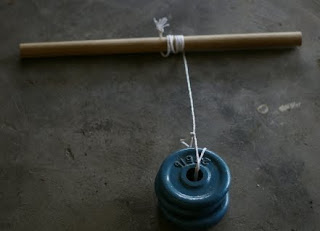
I first got the idea for this from an article by Michael Clarke in Blitz Magazine , and have since refined it after purchasing and reading his book " Hojo Undo - Power Training for Traditional Karate " (a book I would highly recommend, by the way). It's a wrist and forearm conditioner.  You hold it between the hands, and roll the weight up, then down.  After 2 or 3 times doing this, while trying to keep it steady, you can really feel it working.  I use it with hands in the sanchin ready pose, both palms up and palms down, which gives the shoulders and lats a bit of a workout too. Construction was from a scrap of 30mm Mountain Ash dowel I had lying around, some 4mm polypropelene rope and 5kg in dumbbell weights.  A hole drilled through the dowel, and voila, a makiage. The makiage is one of my favourite tools, probably because I like to get close and offbalance/interrupt my opponent by grabbing and pulling, pushing or turning.

DIY Training Equipment #1 - Punching Bag

Image
Being of a frugal and handy nature, I have made many of my training aids myself.  One of the first that I constructed was a heavy punching/kicking bag. New ones of any size cost around $150-$250.  This is money I don't have, and couldn't really justify at this point in time anyway.  So I scrounged around and found enough material to make a functional bag. I used an old brazilian hammock (without the wooden spreader), a 25kg bag of sand, a couple of rubbish bags, lots of old curtains and a couple of rolls of duct tape. To construct it, I taped up the bag of sand into the rubbish bags securely, then wrapped it in about 10cm thickness of old heavy curtains.  This gave me the core of my bag.  I folded the hammock in half, and placed a large wad of curtain in the bottom of the fold.  Then, I hung the hammock by its ends from the garage ceiling and tightly wrapped it up with duct tape, stuffing more curtains around and over the top of it.  Final...